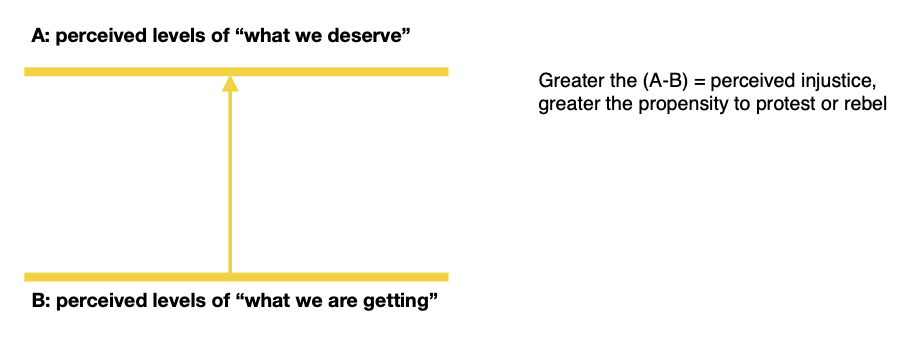
India Policy Watch #1: Nai Umar Ki Nai FasalInsights on current policy issues in India—RSJThere are many striking images that emerged from the students’ protests this week in Delhi. The one that has stayed with me is that of a policeman, wielding an impressively large lathi, beating a young student lying on the ground who continues filming the act on his phone with a sense of glee. Either the lathi was deceptively benign despite its size or the student is so delighted about the prospect of how viral the reel will go on Insta that the pain of getting beaten up is momentarily forgotten. More than a century ago, the great satirist, Akbar Allahabadi, had this to say about the power of the newspaper (or the written word) while fighting a disproportionately powerful adversary: Thanks for reading Anticipating the Unintended! Subscribe for free to receive new posts and support my work. खींचो न कमानों को, न तलवार निकालो जब तोप मुक़ाबिल हो तो अख़बार निकालो (Do not string your bows, nor draw out your swords; When faced against a cannon, bring out a newspaper) Today's youth have replaced newspapers with reels on Insta. For now, that has confounded the government. The best response they have come up with so far was a late-night vertical video address by the PM. It was meh. I might be overreading this. But a party that pioneered social media dominance through creative messages propagated using an army of paid accounts, influencers and bots is now following a trend (vertical video) that has long been the norm for youngsters. This is a signal of a shift, a change in fashion, that the BJP did not anticipate. One of the mistakes we make whenever a protest breaks out is to start judging it. Are the protesters right? Is there an ideological coherence among the protesters? Is there an opposition hand? Who is funding it? The mainstream media loves these questions because they divide the country into neat camps within minutes. Politicians welcome them because every side already knows the answer it wants to give. But if one is trying to understand what is actually happening, these are not particularly useful questions. A protest is not the beginning of a political problem. It is usually the point at which a political problem has hurt citizens long enough that a section of society decides the normal mechanisms of democracy are no longer working. By the time students leave their classrooms, spend days on the streets and risk police action, they have already concluded that waiting patiently is unlikely to change very much. That is how I would look at the student protests that have spread across parts of the country over the past week. The immediate trigger is easy enough to identify. Repeated paper leaks, questions over the integrity of competitive examinations, demands for accountability and calls for the resignation of the Education Minister falling on deaf ears. And then to hear the Chief Justice of India call those up in arms on these issues as cockroaches. Those are the visible demands, and they deserve answers. But they do not fully explain the intensity of the response. Competitive examinations in India carry an emotional weight that goes far beyond the examination itself. It represents years of preparation, family sacrifice, money spent on coaching and, for many households, the belief that merit remains the surest path towards a better life. When that process appears compromised, the reaction is no longer about one examination. People begin questioning whether the larger promise of fairness still exists. Any protest movement fairly quickly figures out that the establishment rarely concedes because of the people assembled on the first day. Governments move when the political calculation changes. Every protest is therefore an attempt to increase the political cost of doing nothing. Once one begins looking at protests in those terms, things become clear. The active coordination to ensure the protests spread from one city to another, the desire to seek wider attention through advance publicity about the protests or the plan to recruit adjacent causes and attempt to build a larger coalition. A movement that begins with paper leaks gradually starts talking about unemployment, fairness, accountability and the future of young people. Critics might describe this as the movement losing focus. It is actually the opposite. The larger the coalition, the greater the political cost of ignoring it. Governments understand this every bit as well as protesters do. Which is why governments across the world, irrespective of ideology, tend to reach for the same set of responses. They negotiate, they reassure, they announce inquiries and promise reforms. At the same time, they question the motives of the organisers and who is funding them (right now mainstream media has everyone from the CIA, China, Soros and Bangladesh in the mix), suggest political interests have attached themselves to the movement, highlight fringe voices (tukde tukde gang) and argue that the issue is being exaggerated. These are not contradictory responses. One attempts to temper public anger. The other attempts to lower public sympathy. Both seek to reduce the political cost that the protesters are trying to create. The state, however, enters this contest with one big structural advantage. It has time on its side. Protesters, on the other hand, have short-term momentum. Protest politics is a contest between those two. Every protest discovers how difficult it is to sustain momentum. Students have classes and tests. Universities can issue threats to those participating, as they have already done in Delhi. People have jobs and families to manage. Public attention is fickle and shifts elsewhere. Governments know this perfectly well. If the political cost remains manageable, time usually begins working in their favour. Protesters know this too, which is why every successful movement tries to create periodic moments of performative symbolism that renew attention and keep the issue alive. The real contest is therefore not between protesters and the government alone. It is over the judgement of millions of citizens who never join a protest but are trying to decide whether the protesters have a point. Governments lose when ordinary people who have no intention of getting out of their homes start stepping out. The success of these protests will depend on the continuous drip of symbolic acts by the protesters and the actions (thoughtful or otherwise) of the government. As I edit this, the news of Pradhan’s resignation has come through. This would haven’t been easy for the party. Pradhan is an organisation man with deep roots who has been responsible for election campaigns across the east and northeast. But the government realised it can’t brazen its way out of this. It has blinked. This will take some sting out of the protests. Governments can disperse crowds, impose restrictions and outlast particular agitations. But if the underlying dissatisfaction continues to grow, it eventually finds another outlet. Democracies possess multiple institutions that are meant to absorb disagreement before it reaches the streets. Parliament is the obvious institution. Universities that encourage free thinking and debates are another. Parliamentary committees, civil society, professional bodies and public consultations all perform the same function. They allow difficult questions to be debated before they become confrontations. Eventually there is the judiciary. When those institutions lose credibility, the street inevitably acquires greater political significance. The discussion around student protests in India eventually goes back to 1974 and the movement led by Jayaprakash Narayan (JP). It is an understandable comparison because that remains the defining example of student unrest contributing to political change. But it is also a comparison that needs to be handled carefully. By 1974, there was already a JP with enormous moral authority. There were Lohiaite socialists, the Jana Sangh, former Congress leaders with mass appeal who had split from Indira Gandhi in 1969 and several regional formations willing to work together despite deep ideological differences. Congress had governed India for almost three decades and longevity had created fatigue. The opposition still possessed the advantage of novelty because it had not yet been tested nationally. The protests became the spark, but there was already enough political material lying around for that spark to ignite something much larger. Today’s circumstances are different. The BJP has governed nationally for a little over a decade, not three. That is a long period in politics, but it is still only half the period that Congress had governed before the Emergency. The opposition does not enjoy the advantage of novelty because most major opposition parties have governed somewhere and carry their own baggage into every election. Nor is there a JP-like figure around whom disparate political forces naturally converge. That does not make the present protests unimportant. It simply means that protests and electoral politics solve different problems. One generates status-quo disrupting energy. The other requires organisation, leadership, credibility and an alternative that enough people are willing to trust. There is, however, one aspect of the present moment that I have written about multiple times earlier too. Every long-serving government eventually discovers that explanations rooted in the failures of previous governments have a limited lifespan. They work for a few years because institutions take time to reform and economies take time to change. But political memory changes with every generation. Anyone below the age of about thirty-six has never voted in a national election that the BJP did not win. For them, the BJP is not one government among many. It is the government. Congress belongs more to history than memory. Their understanding of India has been shaped almost entirely by the present political era. That cuts both ways. The opposition appears unfamiliar. But it also means the present government increasingly owns both the successes and the failures of the present. Accountability shifts towards those who have governed the recent past because lived experience eventually matters more than historical comparison. One can see this transition in the anxieties of young Indians. They are worried about what lies beyond the examinations. Employment is no longer as certain as it seemed a decade or two earlier for the educated. Artificial intelligence is changing the nature of work. Global economic conditions have become more uncertain. Families have invested extraordinary amounts in education for guaranteed upward mobility. That confidence has weakened. I don’t have polled data around this, but I sense the current generation of students is less hopeful about their future than any of the previous generations in the past three decades. The temptation is to ask whether these protests will become another JP movement or whether they will fade away after extracting a few concessions. My instinct is that this is the wrong question. Most protests do not become political revolutions, and governments do not collapse because of one agitation. The more useful question is what these protests reveal about the relationship between citizens and institutions today. The WhatsApp uncles and aunties generation that have seen the benefits of the two decades after liberalisation are content with their “settled” lives, their garba in Vietnam and their misguided belief about India’s standing going up in the world because of this government. But the reality confronting the Insta generation is that their future isn’t as rosy and the correcting and disciplining mechanism of the political system isn’t working. Nobody listens, and nobody is accountable. The government increasingly announces decisions instead of explaining them. The youth is, not surprisingly, assuming bad faith instead of listening. That, more than the current protests themselves, should concern us. Democracies become stronger when they create more places where disagreement can be expressed. That is the sign of a confident government. The youth protesting today are calling out the bluff. Governments do not have to accept every demand placed before them, and protesters do not have to be right about every issue they raise. But both sides have an interest in ensuring that the street remains the last place where a disagreement seeks resolution, not the first place where citizens believe anyone will finally listen. Unfortunately, I believe we have reached there. Addendum—Pranay KotasthaneThis was a big week in Indian politics, and I am not equipped to analyse the political implications of these events. What I know is that next week will bring a stream of articles along the lines of a Ravi-Shastri-esque argument: “In the end, it was democracy that won”. Instead of taking that line, let me offer some frameworks I am using to make sense of what happened. Framework #1In the 1970 book Why Men Rebel?, American political scientist Ted Gurr claimed that one of the reasons why people rebel is relative deprivation. The greater the difference between their perception of “what we deserve” and “what we are getting”, the higher their propensity to protest or rebel.
The reference point for “what we deserve” in the current case is well-paying jobs and prosperity. The reference network for this cohort is not local but international and Western, thanks to social media. Moreover, the government’s forceful assertion that India is already a great power also raises people’s expectations. The perceived levels of “what we are getting” are quite low due to sluggish economic growth, fears of AI taking away jobs, the exam fiasco, and the closure of “exit” opportunities to the West. The gap between these two perceptions—the relative deprivation—is quite high, and hence the protests. While this model is descriptive, it can also be extended to offer some lessons in politics. According to this framework, the government’s aim should be to reduce the sense of relative deprivation. This can be theoretically achieved in two ways. One, by making it clear that “what the protestors are getting” is not that bad a deal. This strategy is difficult to execute beyond fixing the most egregious paper leaks. The global economic environment is challenging and the pace of domestic reforms too slow. Two, by adopting a realist strategy that lowers the protestors’ perception of “what they deserve”. This strategy can backfire: who likes to hear that they don’t deserve the absolute best? But this narrative can be created by acknowledging the economic challenges India faces. As of now, I cannot visualise pathways to close this gap. While the current round of protests has been called off, another immediate cause could provide the impetus for mobilisation. It will be worth tracking the government’s policy positions targeting this age cohort. Framework #2I was intrigued that even those opposing the protests labelled them as Gen Z, a horizontal age-determined collective rather than a vertical group that can be isolated and targeted. Unwittingly, they were conceding that the protestors had created a mass horizontal political identity. Such identities are rare in India, where a deeply held assumption is that the only counter-response to religious majoritarianism is caste mobilisation. One attempt at vertical division can be countered only by another vertical division along a different axis, we are told. But this mobilisation was perhaps the first India-wide movement in the last fifteen years to create and own a new horizontal identity. Framework #3The mobilisation seems to be a canonical case of radically networked societies (RNS) in action. Nitin Pai and I define Radically Networked Societies as:
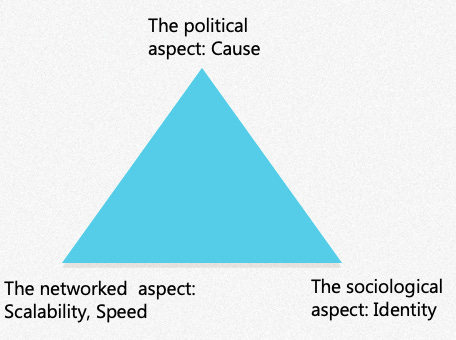
The conceptual framework is illustrated below:
RNS existed in the past, but social media has fundamentally changed the scalability, speed, and depth (the technological aspect), making it easier to bring latent identities and causes to the fore in some cases or to create entirely new causes and identities. What we see today is a clash between contemporary hierarchically ordered states and their radically networked societies. The information flows much faster in a network than in a hierarchical structure. Hence, states are struggling with counter-mobilisation against RNS. All three factors were at play here.
These three frameworks can help us make sense of the events over the last week. In the absence of a credible opposition, the frustration channelled a new path to the ground. While the mobilisation has ended, the repercussions will continue to play out over the next weeks and months, for the self-correcting mechanisms of the Indian political system are well and alive. India Policy Watch #2: Does India Need a Union Education Ministry?Insights on current policy issues in India—Pranay KotasthaneWhile the current Union Education Minister’s resignation is a welcome development for fixing political accountability, it does not address the deeper questions of education governance. So, let me propose an idea that sounds radical but isn’t: India does not need a Union Education Ministry. Before dismissing this as anarchist provocation, do consider that many successful federations in the world manage education without anything resembling India’s sprawling central apparatus, and produce better outcomes for it. The original constitutional design was clear. General education was a State List subject, meaning that states had exclusive legislative power over schools and colleges. The Union’s role was limited to running a handful of central universities (BHU, AMU), governing institutions of technical and scientific education recognised by Parliament as institutions of national importance, coordinating standards in higher education and research (Entry 66 of the Union List), and providing vocational training. The Union Education Ministry existed, but its writ over school education was advisory at best. The Kothari Commission (1964-66) could recommend reforms, but states were free to accept or reject. That changed during the Emergency. The 42nd Constitutional Amendment of 1976 expanded Entry 25 of the Concurrent List to cover “education, including technical education, medical education and universities.” The Union gained legislative competence over all education, from primary school to postgraduate research. Fifty years later, we live with the consequences: a Union Ministry that spends over ₹1.39 lakh crore annually, designs centrally sponsored schemes that states have to implement, runs a national testing agency for entrance examinations, and produces national education policies with binding force. Samagra Shiksha Abhiyan alone commands ₹42,100 crore. Yet its national utilisation rate is a dismal 62 per cent. States propose a plan, the Union’s Project Approval Board approves less, it releases less than approved, and states spend less than released. By the time money filters through this chain, over a third of it doesn’t reach classrooms. The AlternativesIndia’s arrangement looks unusual to many federations. Canada has no federal ministry of education. Education is entirely a provincial responsibility. The Council of Ministers of Education, Canada (CMEC), a voluntary intergovernmental body, coordinates across provinces on standards and credential recognition. It has no binding authority. Despite this, Canada ranked sixth globally in PISA 2022, scoring well above the OECD average in mathematics, reading, and science. The absence of centralised authority has not prevented high or equitable outcomes. Germany operates under the principle of Kulturhoheit der Länder, whereby each of 16 federal states designs its own school system, sets its own curricula, and employs its own teachers. The federal ministry handles research funding and vocational training frameworks but does not control school curricula or standards. The Kultusministerkonferenz (KMK), a standing conference of state education ministers, ensures voluntary coordination, i.e., it’s essentially a standards body, not a governing ministry. Even the US, which created a Department of Education only in 1979, treats education as overwhelmingly a state and local affair. States and local governments provide about 90 per cent of K-12 revenues. NEET Is the SymptomThe consequences of centralisation are not abstract. The National Eligibility cum Entrance Test (NEET) is a direct product of the concurrent list architecture. It is a single centralised examination for medical admissions across the country, designed by a national testing agency, and imposed on states regardless of their preferences. Tamil Nadu has resisted NEET for a decade, arguing it disadvantages students from rural areas and government schools who did well under the earlier state-level, Class 12 marks-based system. Last week, the TVK government demanded that education be transferred back from the Concurrent to the State List. This is an argument against over-centralisation, which creates a single point of failure. Some optionsThe pattern across many federations is that states own education, a lean coordination body sets standards and ensures credential portability, and the centre’s role is limited to research funding, equity-focused transfers, and running a handful of national institutions. Lest we commit the sin of isomorphic mimicry, we cannot assume that what works in these federations will work here. The context is quite different. Our state governments are no paragons of education, and some will perhaps flounder in the absence of Union supervision. Nevertheless, if we assume a time has arrived when we are serious about decentralisation of education, what are some possible options? The most ambitious version of this reform would be to dismantle the Union education ministry and replace it with a coordinating and standards authority. The second option would be to move education back to the State List, restoring the pre-1976 constitutional position. Create a lean National Education Standards Authority—modelled on Canada’s CMEC or Germany’s KMK—for curriculum coordination, credential recognition, and international assessments. Continue running institutions of national importance: IITs, central universities, CBSE and NCERT. A third, less-radical option would be to replace the centrally sponsored scheme apparatus with larger untied fiscal transfers through the Finance Commission. For states with weak fiscal capacity, run a small number of tied grants targeting specific equity outcomes: learning levels, enrolment gaps, and infrastructure deficits. Finally, the Union could voluntarily restrain itself, converting its role from legislator-and-scheme-designer to funder-and-standards-setter, which is what the pre-1976 ministry was. After eighty years of independence and fifty years of the concurrent list experiment, we have enough evidence that the constitutional framers got the design right the first time. HomeWorkReading and listening recommendations on public policy matters
Thanks for reading Anticipating the Unintended! Subscribe for free to receive new posts and support our work.
|