In India, the First Bite of the New Year is Never Accidental
|
Across four regional calendars blooming in mid-April — Puthandu, Poila Boishakh, Vishu, and Baisakhi — the table is always intentional
|
Puthandu — Tamil New Year
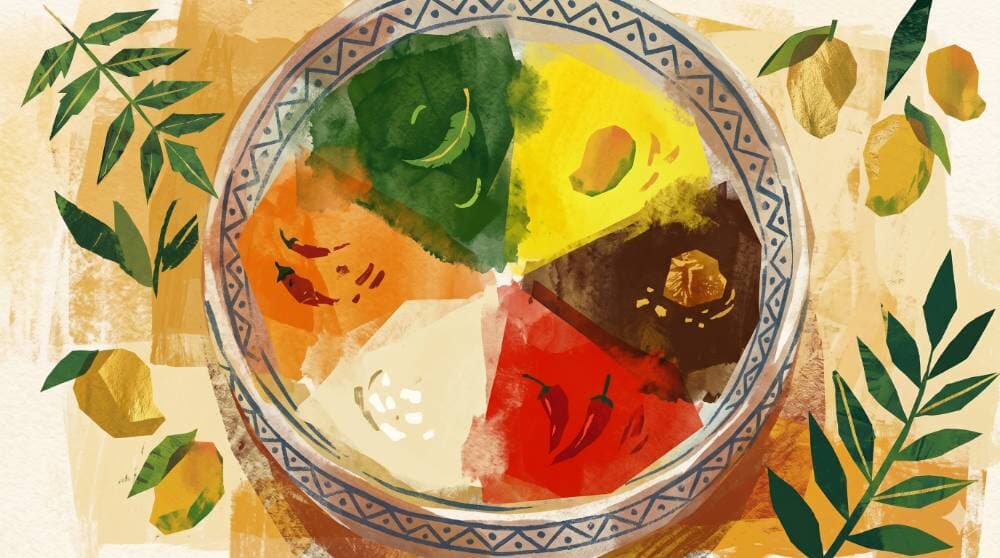
The first meal of Puthandu is built around a single, demanding idea: that a new year deserves all six tastes at once. Sweet from jaggery, sour from tamarind, bitter from neem flowers, heat from chilli, salt from raw mango — the pachadi holds them all, refusing to let you begin the year on just the pleasant notes.
Mango pachadi, sambar, rasam, poriyal, payasam. Neem flower rasam, now gone from most family tables. The first taste, always bitter. "I remember being forced to taste Ugadi Pachadi and hating the bitterness of neem, but being told: 'This is life. You need to accept all of it.' That stayed with me more than the taste itself," says Hosa's brand chef Harish Rao.
|
Poila Boishakh — Bengali New Year
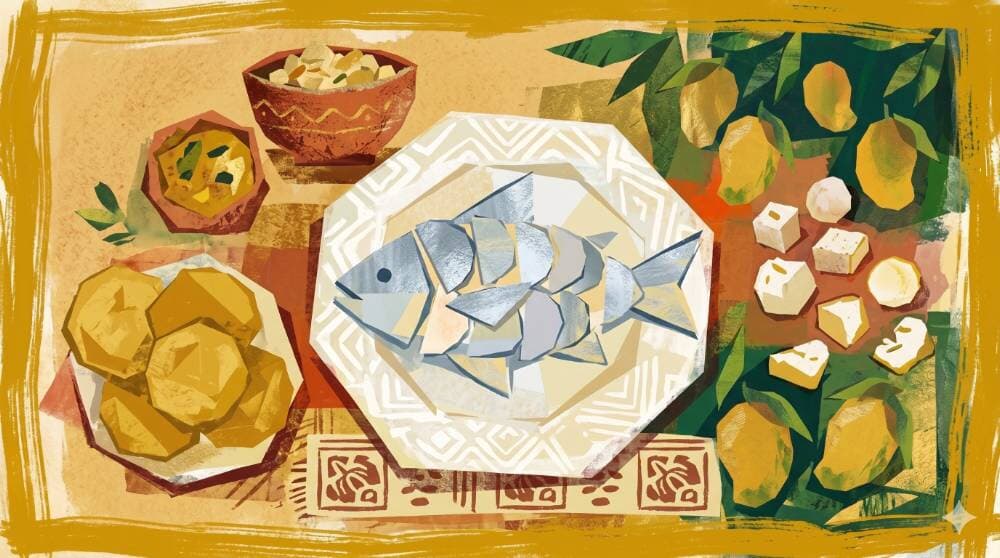
In Bengal, the new year begins with something sweet — a spoon of doi, a piece of mishti — because to start with sweetness is to aspire toward it. Everything that follows is made fresh; no leftovers, no shortcuts. Raw mango, fresh jaggery, nolen gur. Aam pora sharbat, tok dal, luchi, chholar dal. And always, always, ilish.
Somewhere near a home in North Kolkata, a boy once walked to Mahua Misthi Bhandar to bring back warm Langcha and Sitabhog. The walk back, sweets in hand, was its own small ritual. "Poila Boishakh is not just a festival. It's a feeling," says Soham Dhar, Chef de Cuisine, CUR8, Four Seasons Hotel Bengaluru.
|
Vishu — Malayalam New Year
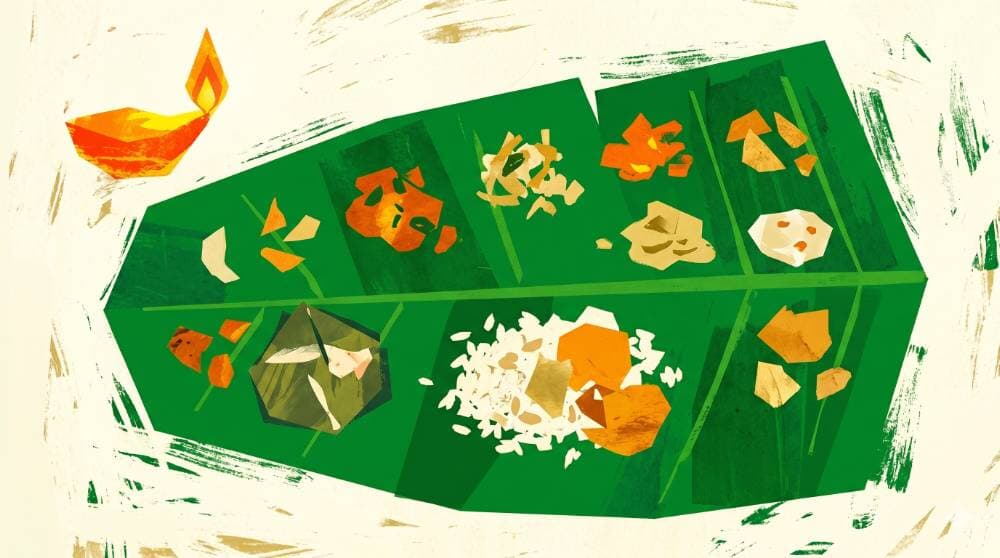
Vishu begins before dawn, eyes closed. A child is carried toward the Vishukkani — an arrangement of auspicious objects, gold, rice, fruit, flowers, a lit lamp — and instructed not to open their eyes until they stand before it. The first sight of the new year is chosen with care.
The sadya that follows is intentional in every element. Avial for abundance. Olan for calm. In Malabar, crispy Ayakoora and Varutaracha chicken curry join the banana leaf. And in one Kannur kitchen, a mother once made Kumbalappam — rice, jaggery, and coconut wrapped in jackfruit leaves and steamed — a flavour that belongs, now, only to memory.
"The flavour imparted by the leaves makes it truly distinctive. It is a preparation I deeply miss today," says Sukesh Krishnan, Executive Chef, Gateway Bekal.
|
Baisakhi — Punjabi New Year
Baisakhi is harvest. It is the wheat coming in, the year turning, the Gurudwara full. The festive table here is simple and indulgent in equal measure — rotis topped with white butter, slow-cooked Punjabi dishes, nothing fussy, nothing unnecessary.
But the one thing that cannot be replicated at home, the one thing that makes the day complete, is Kada Prasad from the Gurudwara. Warm, ghee-rich, given by hand. It is not just food. It is the point.
"The one non-negotiable that feels really special is Kada Prasad from the Gurudwara on Baisakhi," says chef Sombir Chaudary of Kalpaney.
Read the full feature on Slurrp .
|
Hey there, foodie! Naya saal mubarak. Iniya puthandu nalvazhthukkal. Subho Nabo Borsho. Vishu Ashamsakal 🙏 Want to celebrate the new year with us? Just drop in on our Insta page and say hi!
Forward this newsletter to someone who'd love bite-sized tidbits on all things food, or share using the buttons below ⬇️ Got this email from a friend? Sign up !
|
|
|
Fresh neem flowers — 2 tbsp
Raw mango, finely chopped — ¼ cup
Jaggery, grated — 3 tbsp
Tamarind pulp — 2 tbsp
Green chilli, finely chopped — 1
Salt — ¼ tsp
Water — ¼ cup
Ripe banana, sliced (optional, for sweetness) — ½
|
1. Dissolve jaggery in water over low heat, stirring until fully melted. Set aside to cool.
2. In a bowl, combine the cooled jaggery water with tamarind pulp and mix well.
3. Add raw mango, neem flowers, green chilli, and salt. Stir to combine. Add banana if using.
4. Each taste should be present but none should overpower. Adjust jaggery for sweetness, tamarind for sourness, chilli for heat.
5. Allow to sit for 5 minutes before serving so the flavours come together.
6. Offer at room temperature, traditionally as the first taste of the new year.
|
|
|
In-depth, well-researched narratives about food. From the evolution of mock meats, to the cuisine of Gondal's royal kitchen, you’ll find a food story that keeps you hooked.
|
These stories and recipes celebrate a vital part of Indian festivals: food. And our editors will even line up star chefs to share their holiday cooking secrets with you.
|
|
Food journeys that take a turn for the unexpected. Serendipity guides these down-the-rabbit-hole explorations: who knows, poee might just lead to
misal pav.
|
In which Nirmalya Dutta and Avinash Mudaliar pick a theme, any theme, and find a way to introduce readers to all the food trivia that might be linked to that idea.
|
|
|
Hindustan Media Ventures Limited,
Hindustan Times House, 18-20,
Second Floor, Kasturba Gandhi
Marg, New Delhi - 110 001, India
|
DOWNLOAD THE SLURRP APP ⬇️
|
|
|
If you need any guidance or support along the way, please send
an email to slurrp@htmedialabs.com. We’re here to help!
|
©️2026 Slurrp, HT Media Labs. All rights reserved.
|
|
|
|