Home truths: Beware the monster inside

Trouble viewing this email? View in web browser

Sunday, August 27, 2023
By Namita Bhandare

In the public imagination, rape is a crime committed by strangers lurking in dark corners. But an overwhelming number of rapists are known to their victims—a fact the Burari rape underscores in all its sordid details. There’s a trigger warning, but if you can, read on...


The Big Story

Home truths: Beware the monster inside

After her father died of Covid-19 in October 2020, her mother sent her to live with the family of a man she called ‘mama’ (mother’s brother). Like the girl and her mother, Premoday Khakha came from Ranchi. Both families went to the same church (not associated with any diocese) in Burari, Delhi. Moreover, Khakha occupied a position of responsibility as an assistant director in Delhi’s women and child development department.

What could possibly go wrong?

Reports containing details of a police complaint will make you sick. They state that between November 2020 and January 2021, Premoday Khakha repeatedly raped the girl, then aged 16. In January when she got pregnant, she told his wife Seema Rani who blamed her for the crime and then reportedly asked her 22-year-old son to go and buy abortion tablets.

In February 2021, the girl returned to live with her mother, telling her she didn’t like living with the Khakhas without elaborating on reasons why.

Bottling up such a traumatic experience led to anxiety attacks that only seemed to get worse. On August 7 this year, her mother took her to a hospital for treatment and it was during counselling that she spoke about the rape and abortion. A first information report (FIR) was filed at Burari police station on the evening of August 12 but strangely no arrest was made under the stringent POCSO act. Khakha and his wife were arrested only after the police finally recorded the girl’s statement on Monday and the story became public.

The delay in the arrest is most “unfortunate” said Delhi Commission of Women head Swati Maliwal who sat on dharna to try to meet the girl and her mother but was denied access by the police. “There is no deterrence, no certainty of punishment and that is why the intensity, brutality and number of cases is going up.”

“Policing is supposed to create a fear,” she continued. “But obviously people believe they can get away if they are in positions of power, whether it is Khakha or Brij Bhushan Sharan Singh [outgoing president of the Wrestling Federation of India].”

Read: Four women had officially complained about harassment by Khakha

Acquaintance rape
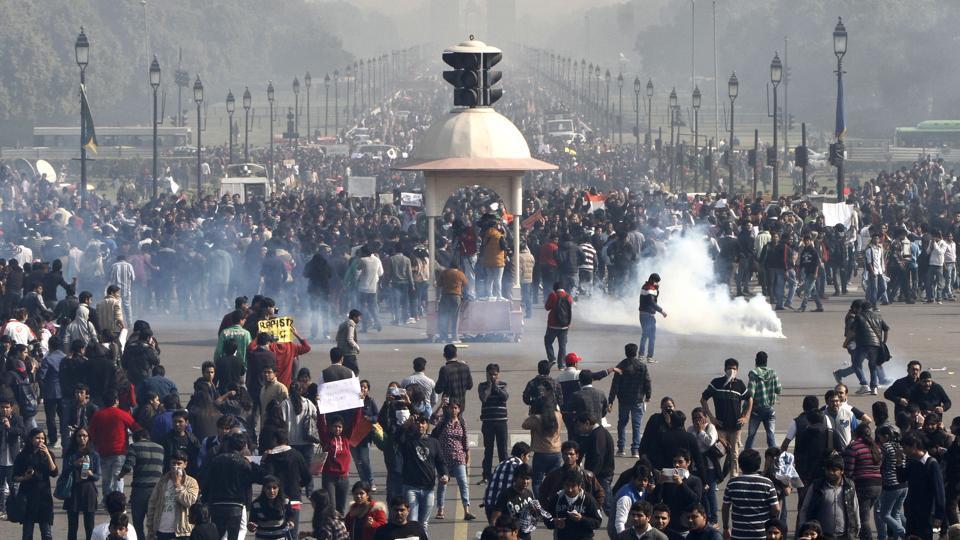
Protests in New Delhi following the gang rape of a 23-year-old woman in December, 2012.(File Photo)

In the public imagination, rape is a crime committed by strangers lurking in dark corners. But an overwhelming number of rapists are, in fact, known to their victims. Of the 31,677 rape cases registered in 2021, 96.5% of cases, were committed by family, friends, neighbours and other known people, finds the National Crime Records Bureau.

A 2015 study by Majlis Legal Centre examined rape and sexual assault FIRs filed in Mumbai between 2014 and 2015 to find that 90% were by people known to the victims, including 16% by a family member (73% of these were a father or a stepfather).

Despite the data, policy around rape focuses on women’s safety in public spaces with the onus placed on women and girls to prevent getting raped either by being discouraged to go out or through self-defence classes and the like.

When boys and men are engaged, it is to appeal to their better instinct as protectors of women. This allows them to “safely distance themselves from ‘men who rape’,” writes Arpan Tulsyan, a development sector researcher. But it also “reinforces the notion of male paternalism”.

It also ignores the rapist at home.

When the rapist is someone within the family—a stepfather or close blood relative—the family might be reluctant to report, particularly if they are financially dependent on him. “There is an attempt to underplay the enormity because in most cases, the accused is a relative, a neighbour or a person known to the child,” says Soha Mitra, director, north, CRY (Child Rights and You). “We have drastically failed to provide a safe environment to our girls. In many cases the ‘protectors’ themselves turn perpetrators.”

This sort of rape often continues unchallenged. Very often since the victims are younger girls, they are unable to articulate what is happening and often even when they do, they are disbelieved. All of this adds to their trauma.

The problem is made worse by the lack of structural support systems like creches for working mothers who live in slums. “When they go out to work, who are they supposed to leave their children with other than neighbours and relatives?” asks Swati Maliwal.

In fact, fear of crime keeps women in outer Delhi at home where they can keep an eye on their children, I found while researching this 2018 story on women and work.

A shameful silence

A still from Mira Nair's Monsoon Wedding

Meera Nair’s 2001 film, Monsoon Wedding brought sexual abuse by family members out into mainstream discussion. Unfortunately, it has been an outlier. The December 2012 gang-rape in Delhi reinforced the idea of unsafe public spaces and stranger rape. In policy terms this was reflected with a growing emphasis on better street lighting and CCTV cameras.

All this is welcome. Yet, despite the data, child sexual abuse by family members is something we still don’t talk enough about.

“There is a complete lack of awareness. It is not in people’s psyche,” says Maliwal.

When she spoke up against her own child sexual abuse by her father in March this year, Maliwal says she was ruthlessly trolled. “All kinds of statements were made that I was putting ‘dirty’ ideas in people’s minds,” she says. But along with the abuse, she also received hundreds of calls from girls and women who were reaching out to share similar stories, she says.

Way forward
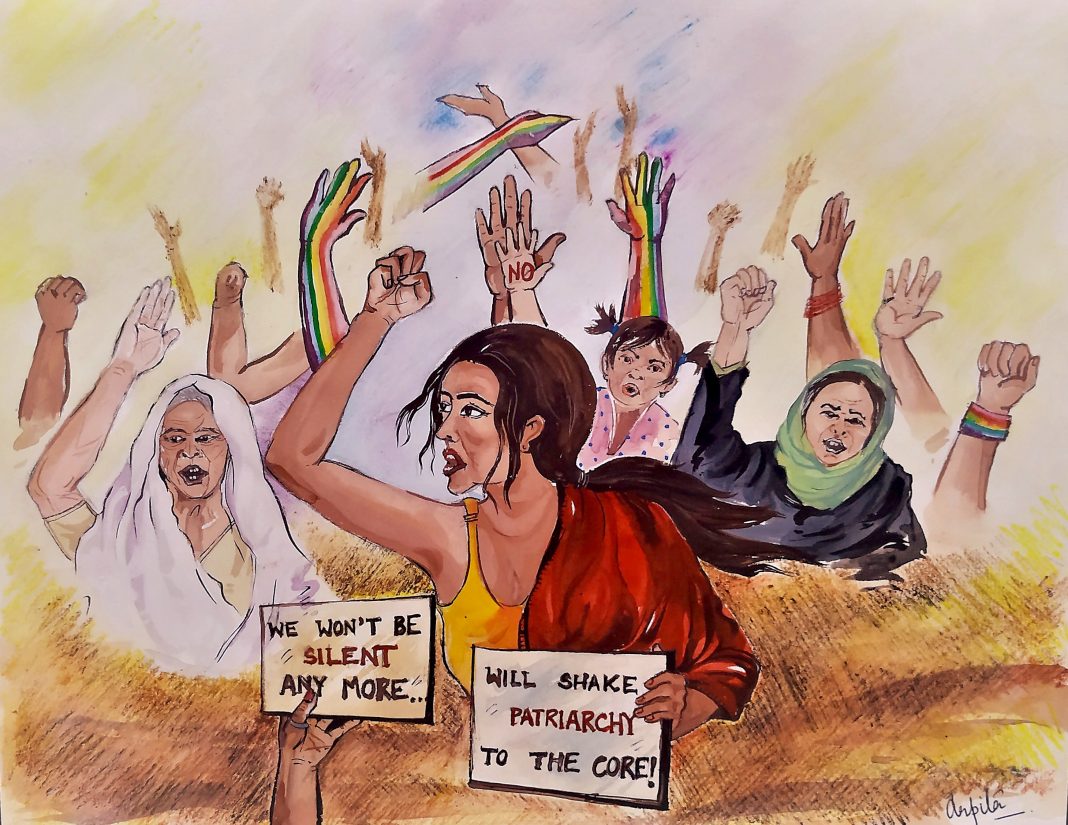
Source: Arpita Biswas/Feminism in India

“In the absence of accommodation and food, the biggest challenge arises when a close family member is involved,” says Delhi-based child rights lawyer, Anant Kumar Asthana. The only option, he adds, is a government or NGO-run child care institution.

There is also a “lack of quality support persons”, continues Asthana and there is need for “substantial improvement in order to be of actual benefit to victims”. What happens on the ground is that “victims lose all existing support [from the family] and hence require speedy financial assistance that is needed to restore agency and dignity of life,” he says.

Maliwal adds: “What we need is a massive awareness campaign.” In incest cases a robust rehabilitation policy is needed to enable the mother to take a stand.

“There is a lot of taboo and stigma and people don’t want to talk about it but it’s high time we broke the silence.”

If you have a complaint or would just like to speak to someone please call:
Childline: 1098
Central police helpline: 112
Helpline: 181

The big fight

People hold banners as they protest against President of the Royal Spanish Football Federation Luis Rubiales (Source: Reuters)

Luis Rubiales, Spain’s football federation president, said he won’t quit even after FIFA began proceedings against him for kissing forward Jenni Hermoso on the mouth on a public stage without her consent. Hermoso wants “exemplary action” against her boss. He claims the kiss was ‘consensual’.

In a sport already plagued by sexism, Rubiales’s kiss has led to worldwide outrage and stolen attention from what should have the team’s finest hour with the World Cup victory.

After initially dismissing those who were protesting as “idiots”, Rubiales issued a belated apology to “any people who felt hurt”. Not enough, said a growing chorus including Prime Minister Pedro Sanchez.

Visuals of Rubiales grabbing his crotch when Spain scored its sole goal against England have gone viral. And former Spanish players’ association employee Tamara Ramos has also come forward to talk of his history of inappropriate behaviour.

At a time when the Women’s World Cup is inspiring girls everywhere to take up football and winning the respect of the world, Rubiales should just go back to the cave from where he’s come.

In New York Times: For girls in Spain, Women’s World Cup win is a joy and a catalyst in New York Times

Can’t make this s*** up

The first menstrual products probably appeared around 1850 but until last week, none of these products, including pads and tampons, had ever been tested by using actual human blood.

Yup, that’s right. Manufacturers have all this time used saline solution when checking absorption, leading to scores of mis-labelled products, finds a paper published by BMJ Sexual & Reproductive Health on August 7.

Why does it matter? For at least three reasons. First, there’s a cost impact on buying wrongly labelled products. Second, there’s a health impact; heavy bleeding leads to decreased haemoglobin and the only way patients are able to quantify this “heavy” is by telling their doctors how often they have to change their pad. Ah yes, and third, it tells you about the priorities women’s health continues to receive from medical research.

What’s making news

Family settlement at Murugappa group

Dr. Valli Arunachalam (Source: HT)

Three years after Valli Arunachalam, daughter of former Murugappa group chairman M.V. Murugappan and a nuclear scientist in her own right, filed a complaint with the company law tribunal charging the men in her family for being unable to “tolerate women in their boardrooms”, the estranged family members have reached an out-of-court settlement, the terms of which have not been disclosed.

Murugappan who died in 2017 had named his wife and daughters in his will, following which Arunachalam had claimed a non-executive seat on the board of the group’s holding firm. When this was denied to her, she sent a legal notice.

Not wanting to live with your husband’s family=cruelty

A week after the Supreme Court released a gender handbook that advocates for removing sexist words and stereotypes in judgments, the Delhi high court ruled that the insistence of a wife to live separately from her husband’s family amounts to cruelty. The court was relying on a 2016 Supreme Court judgment that held that a son has a moral and legal obligation to take care of his parents. In April 2023, the Calcutta high court also ruled that a husband had grounds to divorce a wife for “mental cruelty” if she tried to separate him from his family.

Brij Bhushan’s long shadow

Indian wrestlers will not be competing under the tricolour at the world championships next month. Wrestling’s global governing body on Thursday suspended the Wrestling Federation of India (WFI) for its delay in holding elections and failing to comply with its code of protection of athletes “considering the allegation against WFI’s former president” Brij Bhushan Sharan Singh.

Singh has been charged with sexually harassing and molesting women wrestlers who say the outgoing president now wants to ensure his proxy nominee is elected.

…And the good news

In a win for trans rights, the Allahabad high court has held that gender affirmation surgery is a constitutional right. The court was hearing a case brought by a police constable who had applied to UP police for permission to undergo surgery. The court ruled that a person experiencing gender dysphoria has a right to undergo surgical change.

The Long(ish) read

(Source: Rubin D'Souza/Scroll)

Do chairs have a caste? Yes, if experience in Tamil Nadu is anything to go by. Johanna Deeksha’s deep dive for Scroll looks at how dalit women in the state continue to be discriminated against even after they reach positions of authority. This discrimination can sometimes be insidious as in the sort of chair—an ordinary wire chair, rather than a plush one that can swivel—chosen for a dalit woman sarpanch.

A study, reports Deeksha, found that 64.5% of dalit women were not allowed to drink water from the same container used by other elected representatives, and 38% could not sit on chairs while 67.5% were expected to stand when dominant caste people entered the panchayat office.

Read the article here.

Around the world

In the UK, the only way monster nurse Lucy Letby will leave jail is in a coffin. Guilty of murdering seven babies under her care at the Countess of Chester hospital, the 33-year-old neonatal nurse was also found guilty of attempting to murder another six.

The first warnings came in 2015 when Dr Ravi Jayaram, a pediatrician for nearly two decades, voiced concerns to senior hospital management. But these were brushed off and he was made to attend mediation sessions with Letby.

So, how did she get away with her crimes for so many years? And could she have been stopped sooner if she hadn’t been white? Royal College of Nursing president Sheila Sobrany says race did play a part. Lawyer and activist Shola Mos-Shogbamimu agrees: “They believed her tears/denials even though evidence said otherwise for no other reason than she’s White. A Black or Brown nurse would’ve been reported to the police immediately & sacked for suspicion,” she tweeted.

…And more good news

In a landmark decision, Brazil’s Supreme Court ruled on Tuesday that homophobic slurs are now punishable by prison time. The lead judge said in his ruling that this was a “constitutional imperative” to give LGBTQ+ citizens equal protection under the law.


Were you forwarded this email? Did you stumble upon it online? Sign up here.

That’s it for this week. Do you have a tip or information on gender-related developments that you’d like to share? Write to me at: namita.bhandare@gmail.com.
Produced by Nirmalya Dutta nirmalya.dutta@htdigital.in.

Get the Hindustan Times app and read premium stories
 Google Play Store  App Store
View in Browser | Privacy Policy | Contact us You received this email because you signed up for HT Newsletters or because it is included in your subscription. Copyright © HT Digital Streams. All Rights Reserved

--
Click Here to unsubscribe from this newsletter.

Post a Comment

Previous Post Next Post

Contact Form